How HELOC Variable Rates Work: Index, Margin, and Caps
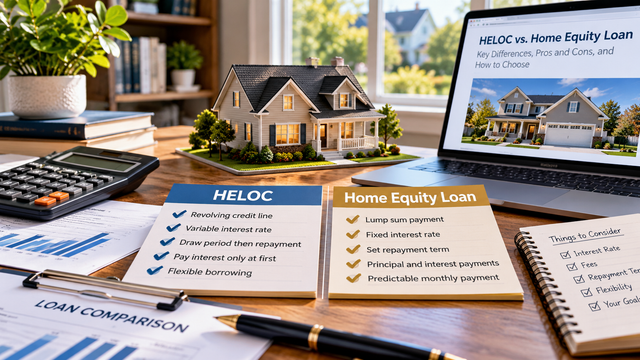
HELOC rates are often variable: the interest charged on a home equity line of credit can rise or fall as a market-based index changes. For many variable-rate plans, the starting calculation is an index plus a lender's margin, adjusted for any introductory offer, caps, floors, and other terms in the contract. That is why a low advertised rate today does not tell you exactly what borrowing will cost over the life of the line.
To understand a HELOC quote, ask four questions: Which index applies? What margin is added? When can the rate reset? What limits apply? This guide explains those moving parts with clearly hypothetical numbers. It focuses on interest-rate mechanics, not on predicting today's HELOC rates or comparing individual lenders.
How Do HELOC Variable Rates Work?
A home equity line of credit, or HELOC, allows eligible homeowners to borrow against their home under an approved credit line. Most HELOCs use adjustable or variable interest rates. That means the applicable rate can change under the plan's terms even if you do not take another advance. The Consumer Financial Protection Bureau (CFPB) explains that HELOC payments can vary with the rate and that the home is collateral for the debt.
Unlike a fixed-rate arrangement, the rate is not necessarily locked for the whole borrowing period. A HELOC may also offer an initial promotional rate or an option to convert some of the balance to a fixed rate. Those features differ by product; do not assume an advertised offer applies to your existing account.
The basic rate formula
Illustrative fully indexed HELOC rate = chosen index + lender margin
The rate that actually applies also depends on the contract's caps, floors, reset timing, promotional provisions, and any rounding rules.
The CFPB's official HELOC consumer booklet describes the index and margin as the two main parts of a variable HELOC rate. A change in the index may affect the rate charged to you when your contract allows an adjustment.
What Is the HELOC Index?
The index is an external reference measure of interest rates. Your contract identifies the specific index, where it can be found, and how its published value is used. The U.S. prime rate and Constant Maturity Treasury (CMT) measures are among examples discussed in CFPB educational material; they are not necessarily the indexes used by every current lender.
An index is not the same thing as your personal HELOC rate. For example, a hypothetical published index value of 6.00% does not automatically mean you would pay 6.00%. The margin and other terms still matter.
Market news about the Federal Reserve may influence an index, but a HELOC does not necessarily reset on the day a central-bank announcement occurs. The index selection, date used, adjustment schedule, and contract provisions determine when an index change affects the borrower's rate.
What Is the HELOC Margin?
The margin is an additional number of percentage points specified by the lender in the plan. It is added to the index in the basic fully indexed rate calculation. A margin of 1.50 percentage points added to a hypothetical 6.00% index produces a 7.50% rate before any applicable contract adjustments.
The margin is different from a one-time fee, and it should not be confused with the percentage of home equity available to borrow. When comparing offers, find the exact margin in the disclosures and ask whether any discounts are conditional on maintaining a particular account or service. The relevant terms—not a generic online formula—control your account.
Example: the same margin with three different indexes
Suppose a hypothetical HELOC has a 1.50-percentage-point margin, with no introductory discount affecting the illustration. The index values in this table are invented teaching inputs, not live market figures or offers. The example assumes no cap or floor is reached.
| Hypothetical index | Lender margin | Calculated rate |
|---|---|---|
| 4.50% | + 1.50 points | 6.00% |
| 6.00% | + 1.50 points | 7.50% |
| 7.50% | + 1.50 points | 9.00% |
These results illustrate the sensitivity of a variable rate to an index. They do not imply that the index will follow these values or that any borrower will receive a particular margin.
How Often Can a HELOC Rate Change?
The reset frequency depends on your agreement. A plan might refer to monthly or another periodic adjustment schedule, but you should check the exact language and the date the lender uses to obtain the reference index. A published index change does not necessarily alter an account rate immediately.
Review the rules on adjustments and the statement showing your current rate. If your line has a temporary introductory rate, determine what happens when that period ends: the subsequent formula may be different from the promotional rate you first saw.
What Are HELOC Rate Caps and Floors?
A rate cap limits how high the interest rate may rise under specified terms. A rate floor may limit how far the rate can fall. Do not assume every contract uses the same design. The CFPB's HELOC comparison worksheet recommends checking the index, margin, adjustment frequency, discount period, and interest-rate cap and floor before selecting an offer.
- Maximum or lifetime rate: the upper limit described in the agreement, which may apply differently under distinct rate or payment features.
- Periodic change limit: some agreements limit how much the rate can rise within a specified interval; others do not provide the same sort of periodic cap. Read the actual disclosure.
- Floor: if included, a minimum contractual interest rate that may prevent the borrower from receiving the full benefit of declining index values.
- Introductory discount: a temporarily reduced starting rate that should not be mistaken for a permanent cap or fixed-rate guarantee.
Hypothetical rate-cap example
Imagine an index rises to an invented 10.00%, and the specified margin is 1.50 points. The formula yields 11.50%. If this hypothetical contract has an applicable maximum rate of 11.00%, that maximum would constrain the charged rate to 11.00% under the assumption that no other provision changes the result. This is not a statement about any lender's current cap or legally required cap.
Even a rate cap is not a monthly-payment guarantee: payment amounts can also change as you draw funds, repay principal, move from the draw period to the repayment period, or encounter a balloon payment under the agreement.
Illustrative Impact on Monthly Interest
Here is a simple way to see why variable HELOC rates matter to a household budget. Assume a $40,000 outstanding balance that stays unchanged for this illustration, with an interest-only draw-period payment. For an approximate month, divide the nominal annual rate by 12 and multiply by $40,000. Actual lenders may accrue interest daily and use a different billing-period calculation, and your account may require principal payments or fees.
| Hypothetical annual rate | Approx. monthly interest | What changed? |
|---|---|---|
| 6.00% | $200 | Lower assumed rate |
| 7.50% | $250 | 1.50 points higher |
| 9.00% | $300 | 3.00 points above first example |
The difference between the lowest and highest hypothetical rates is $100 per month in approximate interest on the unchanged balance. This is not a full payment forecast or quote. If your payment includes principal, a fee, a new advance, or an upcoming repayment transition, the actual amount can be different.
What About Introductory and Fixed-Rate HELOC Features?
Some lenders advertise a temporarily discounted rate for an initial period. Find out how long it lasts, whether it depends on autopay or another condition, and what the rate formula becomes afterward. A promotional interest rate should not be compared with another offer's fully indexed rate without accounting for the transition.
Some HELOC products also permit conversion of part or all of a balance to a fixed interest rate. This may offer more predictable interest costs on the converted amount, but the conversion rate, eligibility, fees, and payment schedule depend on the agreement. The CFPB explains that fixed-rate conversion features are available in some plans; it does not mean the feature is available to every borrower.
HELOC Rates vs. APR: Why Fees Still Matter
The interest formula is an important part of borrowing cost, but it is not a full comparison. Annual fees, origination charges, appraisal expenses, early termination charges, and conversion fees may apply depending on the plan. The CFPB lists examples of possible HELOC fees.
The disclosed APR for a HELOC should be read with its applicable disclosure rules, rather than assumed to include every charge. Compare the actual APR, interest-rate provisions, fees, draw rules, and repayment terms together. A separate APR-focused guide can address APR-versus-rate differences in more detail; this article's purpose is the mechanics of changing rates.
A Rate-Sensitivity Checklist Before You Borrow
Use the following worksheet to compare written offers, not to guess what any lender might approve. For each prospective HELOC, record:
| Item to verify | Where to check or what to ask |
|---|---|
| Index | Name and published source of index; how its value is selected |
| Margin | Exact percentage points added and any contractual conditions |
| Reset schedule | Frequency and timing of permissible rate changes |
| Discount period | Starting rate, end date, qualifications, and rate afterward |
| Caps and floor | Maximum rate, minimum rate, and periodic limits if any |
| Payment type | Interest-only or principal plus interest, during each stage |
| All fees | Opening, recurring, transaction, conversion, and closing charges |
| Rate increase test | Ask lender for illustrative payments at meaningfully higher rates |
Before signing, request the written disclosures and keep copies. CFPB guidance on HELOC disclosures and changing terms explains the types of information lenders must provide about rate adjustments, payment methods, and costs.
How to Prepare for a Possible HELOC Rate Increase
- Locate your contract. Note your index, margin, reset interval, highest possible rate under the agreement, any rate floor, and current outstanding balance.
- Stress-test the budget. Ask what a one-, two-, or three-percentage-point change could do to interest costs, without assuming those are forecasts. Add principal payments where required.
- Check the draw-period ending date. A rate increase and a shift into principal repayment can create different pressures at the same time.
- Review whether further draws are necessary. Borrowing more increases the balance on which interest may accrue.
- Get written explanations. If the rate on your statement does not match your understanding, contact the servicer for the applicable index value, margin, and adjustment calculation.
Because a HELOC is secured by your home, an inability to meet repayment obligations can place that home at risk. Do not base the decision only on an attractive initial monthly payment.
Frequently Asked Questions
Are all HELOC rates variable?
No. Variable rates are common, but some plans include a fixed-rate feature or conversion option. The exact rate structure and eligibility must be confirmed in the particular agreement.
Does the HELOC rate increase immediately when the Federal Reserve changes rates?
Not necessarily. The chosen index may respond to changing market conditions, but your agreement determines when and how the account rate is adjusted. Look for the contractual reset frequency and relevant index observation date.
Can the margin change every time the index changes?
The margin is a separate contract term, not the same as the fluctuating index. Do not assume it changes when the index moves; review the agreement for applicable provisions and ask the lender about any permitted changes.
Do rate caps keep monthly payments from increasing?
No. Caps affect the interest rate within the contract's terms, but payments may still increase because of added borrowing, required principal repayment, or other plan features. Caps do not eliminate default risk.
Can my HELOC interest change if I stop taking new draws?
Yes. A variable-rate account can adjust as the applicable index changes, even when the outstanding balance is unchanged. Actual interest charges also depend on balance and billing-period details.
Bottom Line
Understanding HELOC rates means understanding more than today's advertised percentage. Check the referenced index, the lender's margin, reset rules, caps, floors, promotional features, fees, and how payments are calculated. Compare written offers using those terms, and make room in your budget for the possibility of higher interest costs. Never assume home equity borrowing is risk-free or that a quoted rate will remain in place permanently.
Editorial note: General educational information for U.S. homeowners, not personalized financial, tax, legal, or lending advice. All index values, margins, caps, rates, balances, and payment illustrations on this page are hypothetical examples and not current market quotations or lender offers.
Official references: CFPB: What You Should Know About Home Equity Lines of Credit; CFPB: What Is a HELOC?; CFPB: Possible HELOC Fees; CFPB: Regulation Z Home Equity Plans.


Comments
Post a Comment